


Step into the vast ground-floor gallery of Sydney’s Museum of Contemporary Art (MCA) and the first impression is one of mechanical perplexity. Designer lamps stand beside a towering industrial fan; marquee bulbs flicker erratically; a glowing cluster of power adapters hums quietly as a silvery light glides up and down a vertical pole. Layered beneath the low machine drone are fragments of birdsong and distant barking. Taken at face value, the scene looks like an abandoned film set caught mid-rehearsal—an enigmatic spectacle withholding its script.
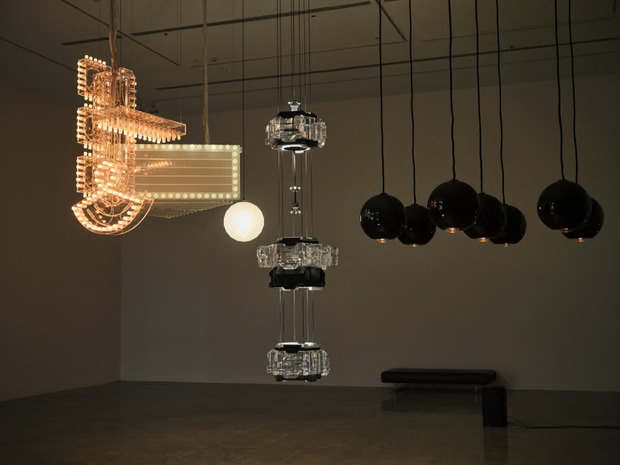
Yet this apparent randomness is precisely the threshold Philippe Parreno (b. 1964, France) invites visitors to cross in Philippe Parreno: 5 Moons, on view across three levels of the MCA through April 26, 2027. Named for the five lunar cycles spanning its run, the exhibition treats the museum itself as a living medium. Following his landmark algorithmic takeovers of Tate Modern’s Turbine Hall and Paris’s Palais de Tokyo, Parreno wires Sydney’s galleries directly to an abandoned almond farm 17,000 kilometers away in south-eastern Spain’s Tabernas desert—turning meteorological fluctuations into a real-time, unpredictable theatrical score.
Moving upward through the MCA’s three floors feels like wandering through a sequence of haunted chambers operated by invisible forces:

- Citrus Dreams and Self-Playing Keys: In an orange-carpeted gallery, helium-filled, fish-shaped balloons drift lazily through the air while an automated grand piano performs an enigmatic, shifting score.
- Bioluminescent Reverie: Elsewhere, a colossal luminescent cuttlefish gazes impassively from a screen, its fins undulating in hypnotic rhythm as swiveling speaker banks emit ambient electronic frequencies.
- The 11-Hour Nocturne: On the darkened third floor, a monumental screen projects an 11-hour film shot on the Spanish almond farm, allowing visitors to sit through an entire nocturnal cycle beneath the Andalusian moon. Live audio streamed directly from the arid terrain fills the room—so that nocturnal Spanish insects mingle uncannily with the low horn of an ocean liner gliding past Sydney Harbour just outside.
The Tabernas desert—celebrated in cinema history as the sun-bleached backdrop to spaghetti westerns such as The Good, the Bad and the Ugly and Once Upon a Time in the West—also carries intimate personal resonance for Parreno, whose ancestors migrated from that very region of Spain to France centuries ago. Sensors planted across the farm continuously transmit wind speed, humidity, and temperature to Sydney, where custom algorithms govern the gallery’s airflow, lighting rhythms, and acoustic cues. The distant land improvises the score; the museum becomes its instrument.
Fiction, Philosophy, and Attention Without Signals
In Parreno’s practice, conceptual backstory functions as essential connective tissue. Consider a white-walled room whose ceiling is blanketed in helium-filled speech-bubble balloons illuminated by flashing colored bulbs: learning that the light pulses spell out a Morse code translation of a mystical adventure by French writer René Daumal transforms a playful visual puzzle into a coded literary transmission.
As Parreno noted during his celebrated 2016 Turbine Hall commission—which was famously driven by biodata from a jar of yeast in a hidden laboratory—many of his installations ask viewers to “endorse a fiction.” Yet beneath the theatrical sleight of hand lies an urgent ecological and philosophical inquiry. When premiering an earlier iteration of the 5 Moons film at Munich’s Haus der Kunst in 2024, Parreno reflected on climate change by asking whether humanity will endlessly reshape the earth, or whether the landscape is finally looking back and speaking to us.
Having previously exhibited in Australia at Melbourne’s ACMI in 2016, Parreno approaches his sweeping Sydney survey with a markedly different ambition than the revolutionary manifesto-making of his late-1980s and 1990s beginnings. Today, he resists the relentless digital economy of notifications and immediate reactions.
Inside 5 Moons, visitors are never forced to obey a linear path or respond to an urgent signal. Instead, anchored between a sun-baked Spanish desert and the shimmering waters of Sydney Harbour, the exhibition grants a rare contemporary luxury: permission to drift with one’s own attention and inhabit time entirely on one’s own terms.