


For more than three decades, Lorna Simpson (b. 1960) has dismantled the expectation that photography must offer transparent, unmediated access to the human subject. Emerging from Brooklyn in the late 1980s and 1990s, Simpson pioneered a rigorous brand of conceptual photo-text practice—pairing crisp, often back-turned studio portraits with engraved plaques and poetic fragments that interrogate race, gender, memory, and the politics of looking.
In recognition of her transformative impact on contemporary art, Simpson has been named the laureate of the 2027 Wolfgang Hahn Prize. Sponsored annually by the Gesellschaft für Moderne Kunst at Cologne’s Museum Ludwig, the award directs an acquisition budget of €100,000 (approximately $105,000) toward bringing a major work by Simpson into the museum’s permanent collection, accompanied by a solo exhibition and dedicated publication in 2027.
Selected by a jury comprising Naomi Beckwith—Deputy Director and Chief Curator of the Guggenheim Museum in New York and Artistic Director of documenta 16—alongside the Museum Ludwig board, Simpson’s honor builds upon an institutional relationship spanning nearly thirty years.
In 1999, Simpson’s seminal two-part photo-text work ID (1990) appeared in Museum Ludwig’s landmark group exhibition Art Worlds in Dialogue (Kunstwelten im Dialog). In ID, Simpson juxtaposes two stark portraits of a Black woman: in the first, the subject turns her back decisively to the camera beside a plaque reading “identity”; in the second, only the crown of her head appears—evoking a planet emerging out of deep space—overlaid with an engraved plaque bearing the active command “identify.” Notably, the museum’s 1999 catalog drew a striking visual parallel between Simpson’s composition and the Black Madonna of Cologne, the revered 17th-century wooden pilgrimage sculpture housed near the museum.
Museum Ludwig’s jury emphasized how Simpson’s multidisciplinary output—which has expanded gracefully over the decades to encompass film, large-scale ink-and-gesso paintings, collage, and sculpture—will enrich the institution’s renowned holdings of American art.
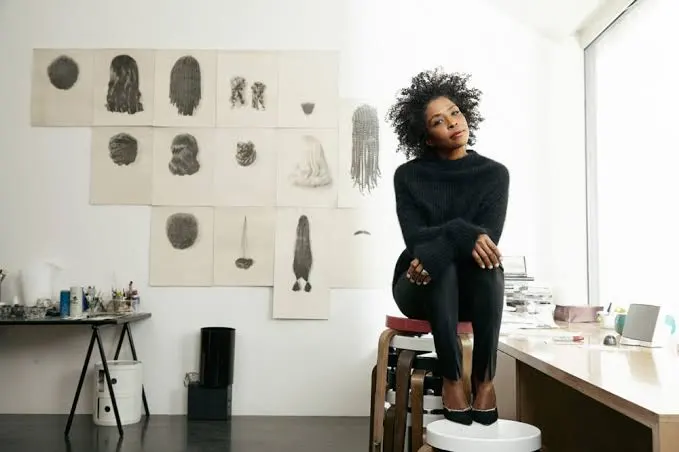
Specifically, the museum noted that acquiring Simpson’s work will deepen its existing strengths in Pop Art and its critique of mass-media imagery—originally championed by founding patrons Peter and Irene Ludwig—while serving as a vital conceptual bridge to younger artists recently added through its Junger Ankauf program, including Diamond Stingily and Carolyn Lazard.
Established in 1994 to honor internationally celebrated artists whose work merits deeper recognition in Germany, the Wolfgang Hahn Prize places Simpson alongside past laureates including Kerry James Marshall, Betye Saar, Frank Bowling, and Haegue Yang. As Museum Ludwig prepares to host her solo presentation in 2027, Simpson’s triumph affirms the enduring power of an artist who turned refusal, poetic restraint, and visual enigma into one of contemporary art’s sharpest instruments of truth.